A Tutor Can Wait.Try 7 Days First.
For parents of kids Pre-K to Grade 8: sort the signs, then test one week of practice.
Where would you put this one?
By Honest Little Apps · Updated November 2026
Does my child need a tutor? A quick answer
Maybe, but test it first. If one subject has been slipping for a term, or homework ends in tears most nights, a tutor is a good bet. If the problem is one shaky skill, try a week of 10-minute daily practice and see if it moves. If your child is far behind in reading, talk to the school before paying anyone.
| What you see | What we would try first |
|---|---|
| Grades slipping in one subject | A tutor for that subject |
| Homework ends in tears most nights | A tutor, or a break from parent-led help |
| One shaky skill the teacher mentioned | One week of 10-minute practice first |
| Reading well below the level for their age | Ask the school for an evaluation |
| Avoids reading or numbers on purpose | Find out why before adding hours |
| Doing fine, you just want an edge | Probably nothing. Reading for fun is plenty. |
Tutoring has strong research behind it. A 2020 NBER review of tutoring experiments by Andre Nickow, Philip Oreopoulos and Vincent Quan found an average effect of 0.37 standard deviations, with the biggest gains from teacher and paraprofessional tutors and in the early grades. So tutoring works. The question is whether your child needs it now, and the cheapest way to find out is one week of watching.
The week before the tutor
A made-up example written by us to show the test. Not a testimonial.
The worryA Grade 3 report card says "working toward" in subtraction. A parent starts pricing tutors.
The testTen minutes after breakfast for seven days. Day 1: 4 of 10 right first try, mood "Hard." Day 4: 6 of 10, mood "OK." Day 7: 8 of 10, mood "Easy."
The callIt moved, so the tutor waits. The routine stays. They plan to run the test again after the next report card.
Tutor vs learning app vs school help vs you
Four honest options. We make one of them, so we have listed where it falls short.
A private tutor
Best for
- A real gap in one subject
- Kids who need a new explanation
- When parent help has turned into fights
School help
Best for
- Long-running gaps
- Suspected learning differences
- In the US, any parent can ask for an evaluation
You, at home
Best for
- Short, calm practice
- Reading together
- Not great if math makes you tense
Brainy Bucks
Best for
- Daily 5 to 15 minute quests your child starts alone
- Missed questions come back later
- Can't explain a concept the way a person can
Signs your child needs a tutor: run the 7-day test
Pick the one skill you're worried about. Practice it for 10 minutes a day, at the same moment each day, for seven days. After each session, write down three things: how many came out right the first time, how your child felt going in, and one thing you noticed. On day 8, read the week.
Download the free tracker (PDF)
One printable page, US Letter, no sign-up. Fill one row a day, then read the three boxes at the bottom. The card sorter at the top saves nothing and sends nothing.
Getting easier
More right first try by day 7, mood mostly fine. Keep the 10 minutes. A tutor can probably wait.
Flat
Same score all week. Ask the teacher if the skill is pitched right. A tutor may help.
Getting harder
Fewer right, more tears, or avoiding it. Stop drilling. Talk to the school about extra help.
Questions parents ask before hiring a tutor
How do I know if my child needs a tutor?
Look for patterns, not bad days: grades slipping in one subject, homework that ends in tears most nights, or a teacher who has raised the same gap more than once. Try a week of short daily practice first. If nothing moves, a tutor is a reasonable next step.
Does tutoring actually work?
Often, yes. A 2020 review of tutoring experiments by Nickow, Oreopoulos and Quan found an average effect of 0.37 standard deviations across the experiments they reviewed. Teacher and paraprofessional tutors did better on average than parent or volunteer tutors, and tutoring during the school day did better than after school.
At what age should a child get a tutor?
There is no set age. The same 2020 review found the biggest effects in the early grades overall, with reading tutoring strongest early and math tutoring stronger in later grades. If a gap shows up in Kindergarten to Grade 2, earlier help is usually easier than later.
Is a tutor better than a learning app?
For a real gap, usually yes. A tutor can see why a child is stuck, explain it a new way and adjust on the spot. An app like Brainy Bucks is better at short, steady practice between sessions, and it costs nothing to try.
Can I just tutor my child myself?
Sometimes. Short, calm sessions help many kids. But a 2015 study of 438 first and second graders found that when math-anxious parents helped often with math homework, their children learned less math over the year. If math makes you tense, a tutor or app may be the kinder option for both of you.
What if the school says my child is fine?
Ask what they are seeing, and share what you see at home. In the US, a parent can ask the public school for an evaluation, and federal rules give the school 60 days from your consent to finish it, unless your state sets its own timeline. Special education services under IDEA are provided without charge.
What a week of practice can't tell you
- It is not an assessment. The tracker helps you notice a pattern. It can't diagnose dyslexia, dyscalculia or anything else. If you see signs from Mayo Clinic's list, like reading well below the expected level for age or avoiding reading, ask for an evaluation.
- Brainy Bucks is not a tutor. It gives practice that adapts to answers, a clue and a second try after a miss, and brings missed questions back later. It can't sit beside your child and explain why borrowing works. The skill statuses in the app come only from answers given in the app.
- Seven days is short. Some skills need longer. If the week is flat but calm, a second week is fair before deciding.
- Parent help has a catch. A 2015 study in Psychological Science of 438 first and second graders found children of math-anxious parents learned less math over the year, but only when those parents helped often with homework. If math stresses you, let the app or a tutor run the practice.
What the test week looks like in Brainy Bucks
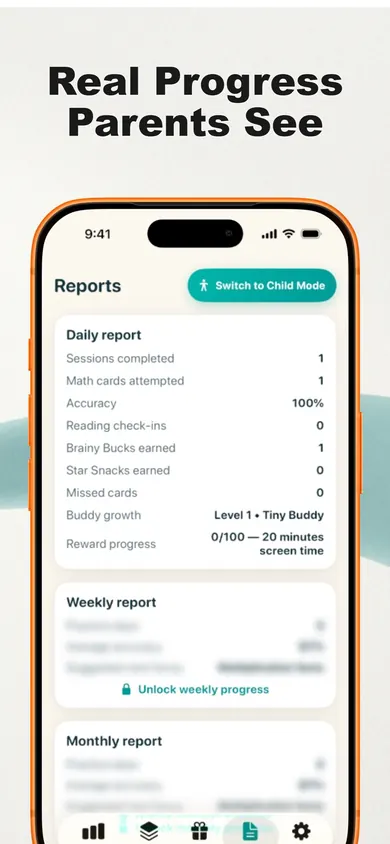
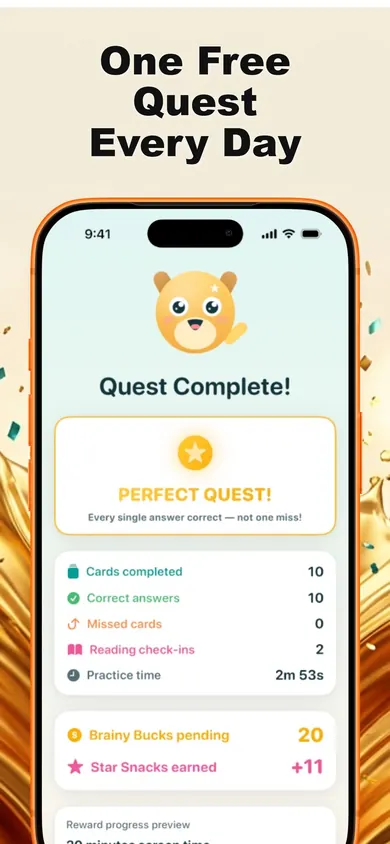
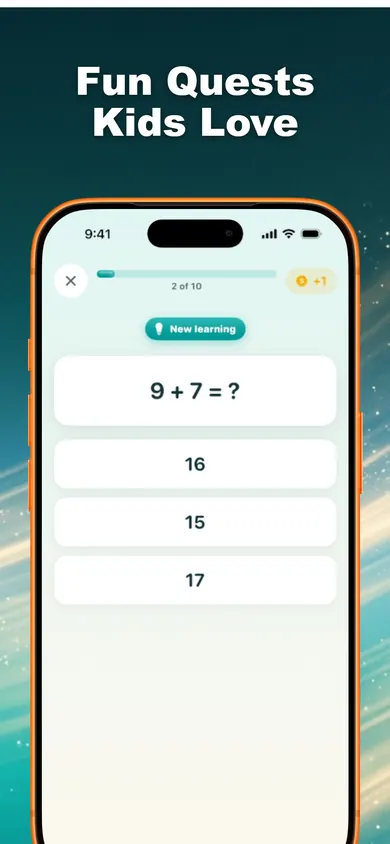
If you run the test with Brainy Bucks, our math and reading app for kids, these are the screens that fill in your tracker. One adaptive quest a day is free. The marker notes are ours.
Get Brainy Bucks free
Print the tracker, pick the skill, and start tomorrow. If the week says “tutor,” you will walk into that first session knowing exactly what to ask for. Read more about how Brainy Bucks works.