Ready Home & FamilyPractical plans for the people at home

Kids Rest.Skills Mostly Stay.

For parents weighing winter break practice: three taps, then rest, read for fun, or 10 minutes.

Question 1 of 3

How is school going right now?

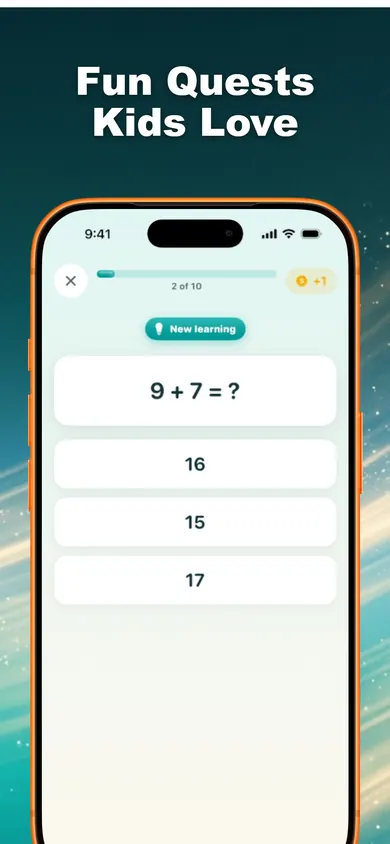
A Brainy Bucks quest question, 9 + 7 = ?, tagged New learning, question 2 of 10
A quest question in Brainy Bucks. A wrong answer gets a clue and a second try.

By Honest Little Apps ยท Updated November 2026

Does winter break cause learning loss?

A little, sometimes, and it usually comes back fast. Kids tend to learn more slowly when school is out, but winter break is about two weeks, and the research on longer summer breaks shows dips that vary a lot from child to child. Most kids need rest more than drills. A few need a short daily anchor.

The research everyone quotes is about summer, not winter. In a January 2023 Brookings piece, NWEA researchers Megan Kuhfeld and Karyn Lewis reported that scores flatten or drop over summer on average, with bigger drops in math than in reading, and that in one study a little more than half of students lost ground while the rest gained. In Education Next in 2019, Paul von Hippel found that in one national study, children lost about two weeks of reading and math skills after their first summer, and in another data set about a month. If ten weeks off costs two to four weeks of skill, a two-week holiday is a small dent for most kids.

So the real question isn't "will my child lose something?" It's "is this child better off resting, or doing 10 minutes a day?" That depends on three things, and the chart below sorts them.

The chart

Winter break learning: the whole decision chart

Winter break practice decision chart Question 1, how is school going: behind for a while leads to talk to the school first; one shaky skill leads to target one skill; on track leads to question 2. Question 2, reading or number play on their own: most days leads to rest and read for fun; some days or rarely leads to question 3. Question 3, how was this term: exhausting leads to rest and read for fun; fine leads to light touch, 10 minutes. 1. How is school going? 2. Reads or plays numbers alone? 3. How was this term? BEHIND FOR A WHILETalk to the school ONE SHAKY SKILLTarget one skill MOST DAYSRest. Read for fun. EXHAUSTINGRest. Read for fun. FINELight touch: 10 min On track Some days or rarely

This is the same logic as the quiz at the top. Your path lights up when you answer it, and nothing you tap is saved or sent. Three plain outcomes:

  • Rest. Read for fun. For kids who already read or play with numbers on their own, and for kids who are exhausted.
  • Light touch. Ten minutes most days: a book, a card game, or one app quest.
  • Target or talk. One shaky skill gets 10 targeted minutes. A gap that has lasted all term goes to the school.

If you land on "light touch," our 10-minute winter break routine for kids shows where those minutes fit on home, family, travel and work days.

A small story

Two kids, one break

A made-up example written by us to show the chart in use. Not a testimonial.

Ava, Grade 2Reads under the covers every night. School is fine. The chart says rest, so her parents just keep the library card busy. In January, she is reading the same level she left on.

Leo, Grade 4His teacher mentioned multiplication facts. He doesn't pick up numbers on his own. The chart says target one skill, so he does one 10-minute quest after breakfast most days. Missed facts come back in later quests. He groans on day one and doesn't by day five.
Who it's not for

When this chart is the wrong tool

Compared

Winter break practice for kids: four options, honestly

Ten minutes a day, four ways. Our app is one of them and we have listed its downside too.
OptionGood atWatch out for
Reading for funVocabulary, stamina, no screen, no fightDoesn't touch math
Card and board gamesNumber sense and family time. Short parent-and-child math chats helped first graders in a 2015 Science study, though that study used a story app, not cards.Needs an adult at the table
School holiday packetMatches what the class is doingYou do the checking; easy to turn into a standoff
A Brainy Bucks quest5, 10 or 15 minutes; adapts to answers; missed questions come back later; read-aloud; offlineIt is screen time; one adaptive quest plus 3 extras a day are free, unlimited needs Plus
FAQ

Questions parents ask about winter break learning loss

Is winter break learning loss real?

Kids do tend to slip a little over long breaks, but the size is debated. The best-known research is on summer: a 2023 Brookings analysis by NWEA researchers found test scores flatten or drop over summer on average, with bigger drops in math than reading, and that about half of students lost ground while the other half gained. Winter break is roughly a fifth as long, so the dip, if any, is smaller.

How much do kids forget over winter break?

There is no good national number for winter break. For summer, estimates vary widely depending on the test, from a tiny gain to a drop of half a standard deviation, according to a 2023 Brookings review. A two-week break is short, and most teachers expect a few days of warm-up in January.

Should my child do worksheets over winter break?

Only if your school sent them, or your child enjoys them. A daily 10 minutes of reading, a card game or one short app quest keeps skills warm with far less arguing. If the break is a fight every day, the practice is costing more than it gives.

How many minutes a day should kids read over the break?

There is no official minimum. We suggest 10 minutes on most days as a floor, because it is short enough to happen on travel and family days too. Kids who read longer on their own should be left alone to do it.

What if my child is already behind?

Then the break is a good time to talk to the school, not to drill. Ask the teacher which single skill matters most. In the US, a parent can ask the school for an evaluation (putting it in writing helps), and federal rules give the school 60 days from your consent to complete it, unless your state sets its own timeline.

Do learning apps help over winter break?

They can, if they are short and your child can start them alone. A 2015 study in Science found first graders whose families used a math story app with them gained in math over the school year, especially when parents were anxious about math. That was one app and one study, so treat it as encouraging, not proof.

The app

What 10 minutes looks like in Brainy Bucks

If your result was "light touch" or "target one skill", here is the app we make for it, as your child and you would see it. More on Brainy Bucks, the math and reading app for kids.

Quest question 9 + 7 = ? with three answer choices, marked New learning
One question at a timeWrong answers get a clue and a second try, not a red X.
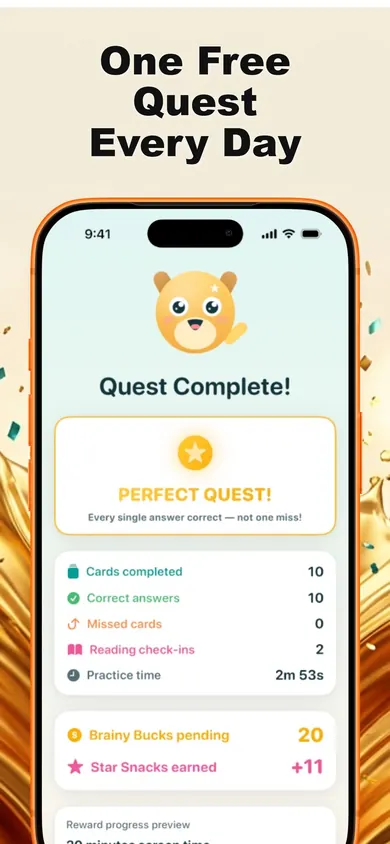
Quest Complete: 10 cards, 10 correct, 0 missed, 2 reading check-ins, 2 minutes 53 seconds
A quest summaryCards done, misses, reading check-ins and practice time.
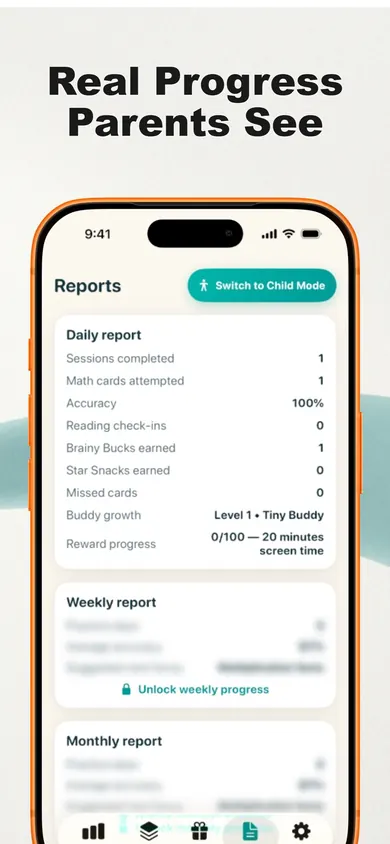
Parent reports screen with a daily report of sessions, accuracy and reading check-ins
What you seeA daily report on the parent side. The weekly summary is free; full weekly and monthly reports are in Plus.

Try it tonight

Answer the three questions with your child's week in mind. If the chart says rest, rest. If it says 10 minutes, set up tomorrow's quest before bed and let it be the first thing after breakfast. See how Brainy Bucks quests work.

Related