For parents · Winter break 2026
The 10-Minute Winter Break Routine
For parents of kids Pre-K to Grade 8: three fixed points a day, and the rest stays holiday.
What kind of day is tomorrow?
| Home all day | Visiting family | Travel day | Parents working | |
|---|---|---|---|---|
| Wake up | Within an hour of the school-day time | Whenever the house wakes up. Don't fight it. | Whatever the departure needs | Your work start sets it |
| 10-minute anchor | After breakfast, before any screens: a book or one quest | Read with a grandparent or cousin for 10 minutes | In the car or at the gate: an offline quest, a book, or license-plate math | Same time daily, set up before your first call so they start alone |
| Move | An hour outside or active play before lunch | A walk to the park with whoever is around | Stretch and walk at every stop | Outside or active play before lunch |
| Screens | After the anchor and the active hour | Shared: one movie together beats six tablets | Downloaded shows for the long stretch. Travel rules are different. | In blocks you set, after the anchor |
| Bedtime | Same as school nights, give or take an hour | Up to an hour late is fine. Back on track the next night. | Anything goes. Reset tomorrow morning. | Same as school nights |
Home all day: wake, a 10-minute anchor and bedtime stay fixed. Everything else is holiday.
By Honest Little Apps · Updated November 2026
What should a winter break routine for kids look like?
Keep three fixed points and let the rest float: wake up within about an hour of the school-day time, do one 10-minute learning anchor at the same moment each day, and keep bedtime close to normal. That is enough shape for kids to feel the day, and loose enough for a real holiday.
- Wake-up window. It keeps the first school morning in January from being a shock.
- One 10-minute anchor. Reading, a number game or one app quest. Tie it to something that happens anyway, like breakfast.
- Bedtime. The one most worth guarding.
Sleep and movement don't take a holiday. The CDC recommends 9 to 12 hours of sleep a night for children aged 6 to 12, and 10 to 13 hours, naps included, for ages 3 to 5. It also recommends 60 minutes or more of moderate-to-vigorous activity every day for ages 6 to 17. Most of a good winter break day is just those two things plus fun.
Why 10 minutes? It is short enough that nobody argues, and long enough to keep reading and number facts warm. Spreading practice out tends to beat cramming it into one sitting when it comes to remembering things later; a 2006 review in Psychological Bulletin pooled 317 experiments on this spacing effect. So ten minutes a day across a two-week break is likely to do more than one two-hour catch-up session on New Year's Day.
When to skip this routine
- Your school sent a holiday packet or reading log. Use that as the 10-minute anchor instead of adding more.
- Your child is wiped out after a hard term. A week of nothing is a fair call. Our winter break learning loss chart helps you decide whether practice is even needed.
- Your child has an IEP or a tutor. Ask the teacher or tutor what to keep going over the break, and use that.
- Your child is under 3. The anchor is a picture book on your lap, not an app.
A winter break schedule for kids in 3 steps
Hang the anchor on something that already happens
After breakfast, after the dog walk, before the first show. The same moment every day works better than the same clock time, because holiday clocks drift.
Decide what fills the 10 minutes
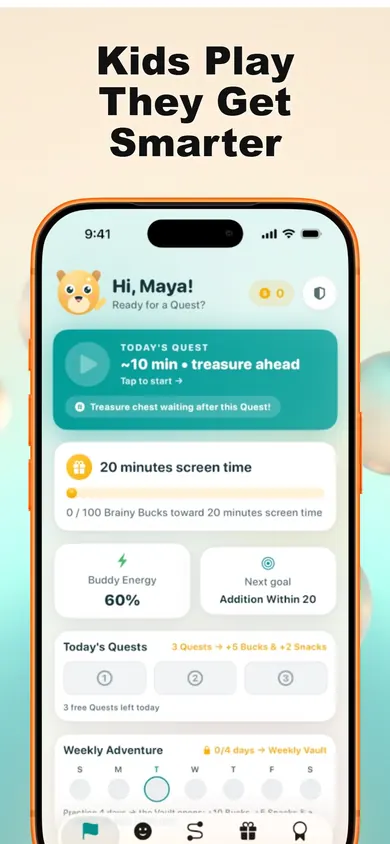
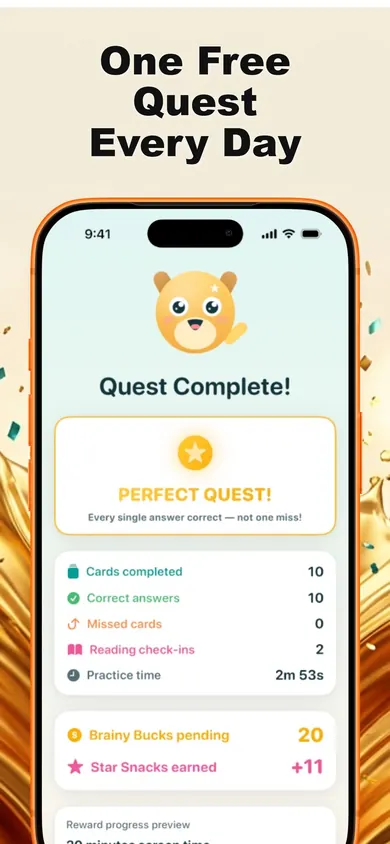
A library book, a card game with numbers, or one quest in Brainy Bucks, our math and reading app for kids. A quest runs 5, 10 or 15 minutes and mixes new skills with review and earlier mistakes. One adaptive quest is free every day, and it works offline, which helps on travel days.
Put tomorrow on the fridge
Pick the kind of day in the table at the top, press Print this day, and point at the sheet instead of negotiating. Nothing you pick here is saved or sent anywhere. A break usually mixes two or three kinds of day, so print one for each.
Screen time over winter break, and what 10 minutes won't do
- It won't catch up a child who is well behind. If a teacher has flagged reading or math, ten minutes of general practice is not a plan. Our page on whether your child needs a tutor has a 7-day test to run first.
- An app quest is still screen time. We built Brainy Bucks to be short and calm, and it has screen-free parent-and-child activities for exactly this reason. On half the days, we would rather the anchor was a book.
- Careful with screens as the prize. Brainy Bucks lets you create real-life rewards; the example in our own screenshots is 20 minutes of screen time. A 2018 study of Canadian families with children aged 1.5 to 5 found that using screens to reward or punish behavior went with more weekend screen time, not less. If that worries you, make the reward a park trip or picking dinner.
- Routines slip on holidays. That's fine. Restart the next morning; nothing is lost in a day.
One family's break, three fixed points
A made-up but realistic week, written by us to show the routine. Not a testimonial.
Mon, Dec 21 · Home dayPancakes, then a 10-minute quest before the TV goes on. A subtraction fact that went wrong last week comes back. Second try, right.
Thu, Dec 24 · Visiting GrandmaNo app. Grandma reads two chapters with them on the couch. That counts. Bedtime is an hour late and nobody worries.
Sun, Dec 27 · Travel dayFour hours in the car. Ten minutes of license-plate math, one offline quest at the rest stop, then downloaded shows. Bedtime is whenever they fall asleep.
Fri, Jan 1 · Home dayBack to the home column. Wake-up drifts back toward school time over the last three days, so Monday morning isn't a fight.
Winter break activities for kids at home: what fills the 10 minutes
Each of these is a fine anchor. Rotate them. Here is how we see the trade-offs, including where we lose.
A library book
- No screen at all
- Works for every age
- Hard to tell what stuck
Card and dice games
- Real number sense, family time
- Kids ask to play
- Needs a grown-up at the table
Worksheet packet
- Matches school work
- You do the checking
- Often the start of a standoff
A Brainy Bucks quest
- Kids can start it alone
- Missed questions come back later
- Read-aloud and offline
- Still a screen
Try it tonight
Set up tomorrow's 10 minutes before bed: pick the day above, print it, and put a book or the app where your child will see it at breakfast. You can read more about how Brainy Bucks works for parents first.