What bathroom safety equipment do seniors actually need?
Usually three things: something to hold, something to sit on, and something that doesn’t slip. That means grab bars by the tub and toilet, a shower chair or a tub transfer bench, and non-slip mats in and outside the tub. A raised toilet seat or safety frame helps if getting up is hard. The trick is knowing which name fits which problem.
The CDC’s fall prevention page (reviewed January 2026) puts grab bars inside and outside the tub or shower and next to the toilet on its short list. The rest of this glossary is the vocabulary you need in the store aisle, or on the phone with whoever installs it. Each term is the one people search for, with what it is and what it gets mixed up with.
This is general information, not medical advice. Talk to your clinician. An occupational therapist can tell you which of these fits a particular person.
GlossaryGrab bars, shower chairs and transfer benches, defined
- Grab bar
- Towel bar
- Shower chair
- Tub transfer bench
- Handheld shower
- Non-slip mat and decals
- Raised toilet seat
- Comfort-height toilet
- Toilet safety frame
- Curbless
- Threshold
- Lever handle
- Anti-scald setting
- Night light
- Grab barmounted to the wall
A bar screwed securely into the wall to hold while you sit, stand or step. The CDC suggests grab bars inside and outside the tub or shower and next to the toilet. MedlinePlus says to mount them vertically or horizontally, not diagonally.
For reference, the ADA Standards for public restrooms set bars 33 to 36 inches above the floor, 1¼ to 2 inches in diameter, 1½ inches from the wall, holding 250 pounds of force. Homes don’t have to follow them.
Mixed up with: Not a towel bar. MedlinePlus: “Do not use towel racks as grab bars. They can’t support your weight.”
- Towel barfor towels only
A rail for towels, usually held by small screws or anchors. It may look like a grab bar and it may even hold once. That’s the danger.
- Shower chair (bath chair)sits inside
A seat with legs that stands inside the shower or tub, so you can wash sitting down. MedlinePlus suggests sitting on a bath chair or bench to shower, and its hip and knee surgery page suggests rubber tips, and no arms if the chair goes in a tub.
Mixed up with: Still means stepping over the tub wall to reach it.
- Tub transfer benchstraddles the tub wall
A long bench with two legs inside the tub and two outside. You sit down outside the tub, slide across, then lift your legs over. Nobody has to step over the tub wall standing up.
Mixed up with: People search “bath seat” and buy a shower chair when the hard part was the tub wall.
- Handheld showera shower head on a hose
A shower head on a hose that you can hold while sitting. In accessible public showers, the ADA calls for a hose at least 59 inches long that works fixed or handheld.
- Non-slip mat and decalsin and out of the tub
MedlinePlus suggests non-slip suction mats or rubber silicone decals in the tub, and a non-skid bath mat outside it for firm footing. Mayo Clinic says the same for showers.
- Raised toilet seatan add-on
A thick seat that sits on the existing toilet bowl to make it higher. MedlinePlus says raising the seat height can reduce fall risk. The NHS suggests borrowing, hiring or buying one before a hip replacement, and says your care team can advise where.
Mixed up with: Not a comfort-height toilet, which is a whole new toilet.
- Comfort-height toileta taller toilet
A toilet with a taller bowl, sometimes sold as “chair height”. The ADA puts public accessible toilet seats at 17 to 19 inches above the floor, which is the range these are usually sold against.
- Toilet safety framearms around the toilet
A freestanding frame with armrests on both sides, for pushing up from the seat. It needs no drilling, and it’s an option when there’s no wall stud for a bar.
- Curbless (roll-in) showerno lip
A shower with no step at the entry, so the floor runs straight in. In the ADA Standards, a roll-in shower’s threshold is half an inch at most. Usually a remodel.
Mixed up with: Not a low-threshold shower, which keeps a small, easier lip.
- Threshold (change in level)any lip you step over
Any raised edge between floors: a shower lip, a doorway strip. The ADA allows a quarter inch straight up, or up to half an inch if beveled. A higher lip is something to step over.
- Lever handlefaucets and doors
A handle you push down instead of gripping and twisting. The ADA describes controls that work with one hand and no tight grasping, pinching or twisting of the wrist.
- Anti-scald settinghot-water limit
MedlinePlus suggests keeping the water heater at no more than 120°F (49°C) to help prevent burns. Check the dial before the first bath.
- Night lightthe route to the bathroom
A small light near the floor for the walk to the bathroom at night. Mayo Clinic suggests them in the bedroom, bathroom and hallways.
Not for everyoneSkip this list, and RoomMend, if…
- Someone has fallen, feels unsteady or is scared of falling. Ask their clinician about a home safety evaluation first. Our pro vs DIY home safety check guide explains why.
- You’re planning a bathroom remodel. A contractor, ideally one trained in aging in place, will spec the curbless shower and the blocking for bars.
- You want an app that tells you what to buy. RoomMend doesn’t sell or recommend products, and it doesn’t look at your photos.
Your quiz resultAging in place bathroom changes, matched to the problem
The quiz at the top runs on this table. If you skipped it, here’s the logic in full.
| If this is hard… | Words to search |
|---|---|
| Stepping over the tub wall | Tub transfer bench, handheld shower, a grab bar at the tub entry |
| Standing for a whole shower | Shower chair and a handheld shower |
| Getting up from the toilet | Raised toilet seat or toilet safety frame, a grab bar beside it |
| Slipping on wet floors | Non-slip mat and decals, a night light for the route |
| The step into the shower | Ask about a curbless or low-threshold shower; that’s a remodel |
The appA bathroom safety checklist for seniors, on your phone
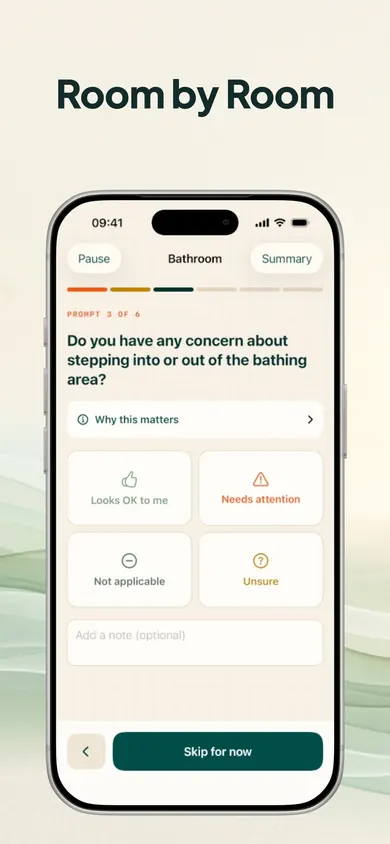
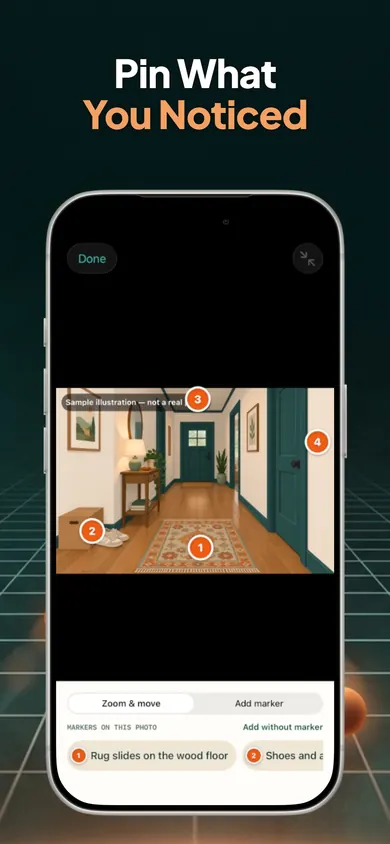
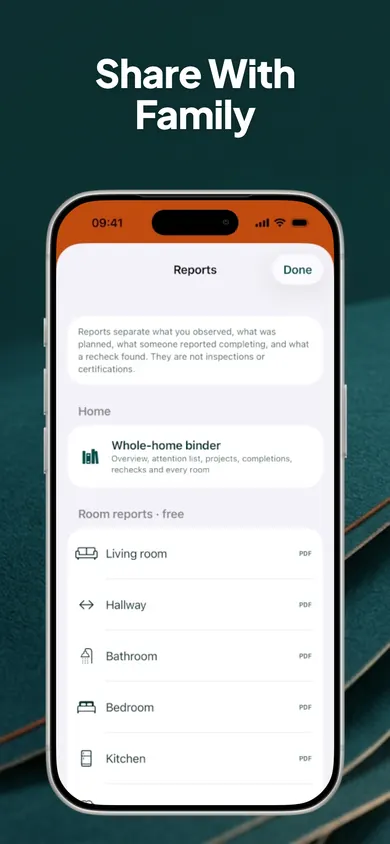
RoomMend, our room-by-room home safety checklist app, keeps the list of what the bathroom needs and who’s getting it. Its bathroom walkthrough asks guided questions based on public guidance from the CDC, the National Institute on Aging, NFPA and CPSC. The quick note has “Handrail or grab bar” and “Slippery surface” as one-tap issues.
A scenarioThe bath seat that didn’t fit the problem
This one is invented, but we heard versions of it while designing the walkthrough.
A son orders a “bath seat” for his mother: a shower chair with a backrest and four rubber feet. It’s solid and it fits in the tub. She thanks him and never uses it.
The trouble was never standing in the shower. It was lifting one leg over a tub wall, wet, while holding a towel bar. A chair inside the tub sits on the far side of exactly that step.
What she needed was a tub transfer bench, which takes the step away, and a grab bar where her hand already goes. Prompt 3 of RoomMend’s bathroom walkthrough asks about stepping into or out of the bathing area, which is the question he skipped.
ComparedBuy it, borrow it, or have it installed
Borrow or hire
Raised toilet seats, shower chairs, transfer benches. The NHS suggests borrowing, hiring or buying a raised seat before hip surgery, and says your care team can advise where. Ask a hospital team or local agency on aging what lends equipment near you.
Buy off the shelf
Non-slip mats and decals, night lights, a handheld shower head that swaps for the old one, a toilet safety frame. No tools, or only basic ones.
Have it installed
Grab bars into studs or blocking, lever faucets, a curbless shower. Anything that holds a person’s weight is worth paying someone to mount.