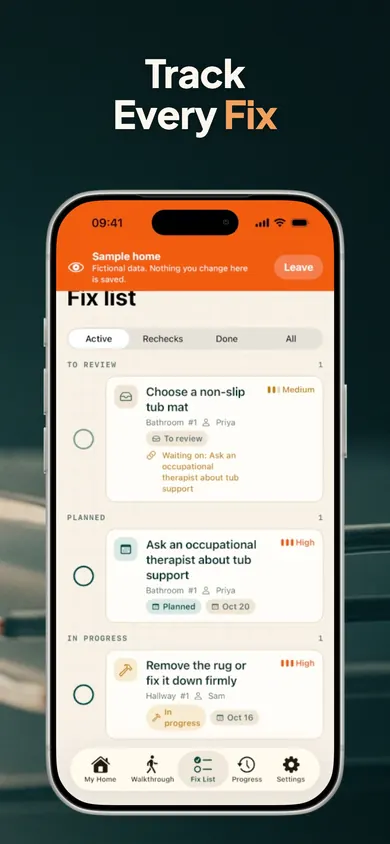
Do you need a professional home safety assessment, or is a DIY checklist enough?
It depends on the person more than the house. If your parent has fallen in the past year, feels unsteady, or worries about falling, ask their clinician about fall risk and a home safety evaluation by an occupational therapist. If none of those is true, a careful room-by-room walk with a checklist covers the common hazards.
Those three questions come from the CDC’s STEADI screen for clinicians, where a yes to any one means the person is at risk. STEADI suggests checking the home for hazards like throw rugs and slippery tubs, and referring to an occupational therapist when hazards are likely.
The evidence points the same way. A 2023 Cochrane review of 14 home-hazard studies found these interventions cut the rate of falls by 38% for people at higher risk of falling (high-certainty evidence). For people who weren’t selected for risk, it found no reduction. The fixes matter most where the risk is real.
ComparedOccupational therapist home safety evaluation vs a DIY walkthrough, side by side
| Printed checklist | Checklist app (RoomMend) | Occupational therapist | Aging-in-place remodeler | |
|---|---|---|---|---|
| Looks at the person | No | No | Yes. That’s the job | Sometimes, for the design |
| Looks at the house | Yes | Yes, with guided questions | Yes | Yes, with an eye on building it |
| Recommends equipment | General tips | Suggests fixes for common issues | Yes, fitted to the person | Installs it |
| Tracks who fixes what, and rechecks | No | Yes, with 30-day rechecks | A written report | Until the job is done |
| How to get one | Print it | Free on iPhone | Ask the clinician for a referral | Get quotes |
Two notes. An occupational therapist’s job, per the Bureau of Labor Statistics, includes evaluating a client’s home to identify accessibility improvements and recommending special equipment. That’s judgment about a particular body, not just a particular bathroom. And the Certified Aging-in-Place Specialist (CAPS) designation from the National Association of Home Builders trains remodelers in home modifications for aging in place. Ask about coverage and price before you book either.
A bathroom, checked: two grab bars, a non-slip mat, a night light, and one towel rack that isn’t a grab bar.
Not for everyoneWhen a checklist app isn’t the answer
- Your parent has fallen, is unsteady, or is scared of falling. Start with their clinician. An app can track what the OT suggests, but it can’t replace the visit.
- You need grab bars, rails or a new shower installed. That’s a contractor’s job.
- You need a home inspection for a sale or insurance. RoomMend isn’t one.
Honest limitsWhat a DIY home safety check can’t see
- Balance, strength, eyesight and medicines. The CDC’s fall prevention steps start with the doctor, a medicine review, leg and balance exercise and a yearly eye exam. A walkthrough only covers the home part.
- How a person actually moves. A checklist asks “Is there a grab bar?” A therapist watches someone step out of the tub.
- Whether the fix was done right. RoomMend’s “Reported completed” means someone said it was done; the app can’t verify it, which is why it asks you to look again.
- Hazards in photos. RoomMend doesn’t analyze them. You decide what you noticed.
- Electrical, gas, structural, fire-safety or mobility concerns. Those need a qualified professional.
For reference only: the ADA Standards for public buildings put grab bars 33 to 36 inches above the floor and require them to hold 250 pounds of force. Private homes don’t have to follow them, which is one more reason the person matters more than the rulebook.
This is general information, not medical advice. Talk to your clinician.
A scenarioA Saturday walkthrough that turned into a referral
This is made up, but it’s the case we built the fix list around.
A daughter spends Saturday at her dad’s house with a checklist app. The hallway rug slides, the hall is dim at night, and the smoke alarm hasn’t been tested in a while. Three quick notes, three fixes. That part goes the way a DIY walk should.
Then, in the bathroom, he mentions he grabbed the towel rack getting out of the tub last week. It held. He laughs about it.
That’s two of the three STEADI questions in one sentence: unsteady, and probably worried. She doesn’t add “buy a grab bar.” She adds “Ask an occupational therapist about tub support,” and sets the tub mat to wait on it. The checklist did its job. It found the moment to stop doing it yourself.
Try itWhich home safety check fits? Five questions
Answer for the person who lives in the home. The first three are the CDC’s STEADI questions.
How it worksA room-by-room home safety checklist app in three steps
If the DIY walk is the right call, or you’re doing it alongside a pro, this is how RoomMend, our room-by-room home safety checklist app, runs it.
- Set up in one step
Pick Apartment, One-floor house or Two-floor house and the rooms are ready. No address, location or account.
- Note it in three taps
Room, issue, when. RoomMend suggests the fix, and a photo with a numbered marker is optional.
- Tick it, then look again
Mark a fix done and RoomMend plans a reminder to check it again in 30 days.
The tourInside the app: walkthroughs and quick notes
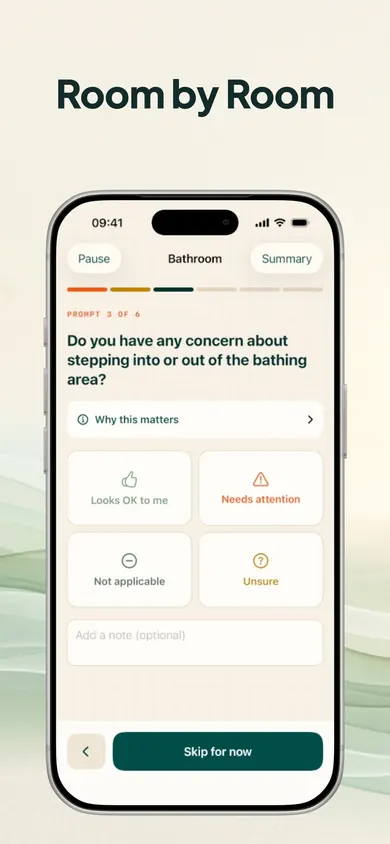
Room walkthroughs
Guided questions for bathrooms, hallways, bedrooms, stairs, kitchens, entrances and more, based on public guidance from the CDC, the National Institute on Aging, NFPA and CPSC. Pause and resume any time.
- “Why this matters” shows why each question is asked and where it comes from.
- “Needs attention” puts it on the fix list.
- “Unsure” is a real answer, and a good one to bring to a pro.
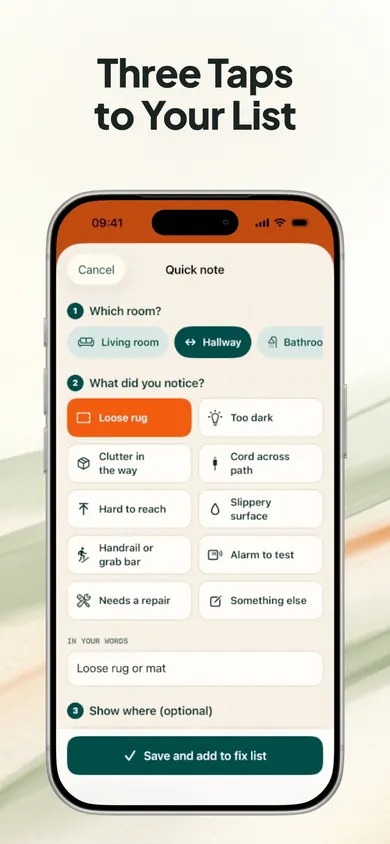
Three-tap quick note
Spotted something outside a walkthrough? Room, issue, when: This week, This month or Someday. A photo with a marker is optional.
- Pick the room.
- Tap what you noticed: Loose rug, Too dark, Cord across path, Hard to reach.
- Save it to the fix list.
Every walkthrough, the fix list, reminders, rechecks and room PDFs are free. RoomMend Plus is a one-time purchase for more homes, more photos per room, the whole-home binder PDF and a few extras. No subscriptions.