How do you make a family emergency plan with kids?
Do it in small pieces, out loud, with the kids doing parts of it. A plan with kids needs four things they can remember: two meeting places, one out-of-area contact, two ways out of every room, and a practiced drill. Add a card for each person and a kit. Seven short evenings covers it.
We split it into nights because nobody sits through a two-hour family meeting about disasters, least of all a seven-year-old. Each night has one job and ends with something real: a spot you walked to, a number someone has texted, a box with today’s date on it.
Free printable tracker (PDF)One page: the seven nights, blanks for your meeting places and contact, and a review date. No sign-up.The challengeThe 7-day emergency preparedness challenge, night by night
Nights 1 and 2 in one picture: home, two meeting places, one contact far away.
Night 1: Pick two meeting places
10 minutes, plus the walk
One right outside the house for a fire, like the mailbox or a neighbor’s tree. One outside the neighborhood in case you can’t get home, like the library. That’s the American Red Cross setup. Then walk to both.
With kids: Let the kids name the spots. “The big oak” sticks better than an address.
Night 2: Choose one contact far away
10 minutes
Pick a relative or friend in another area who everyone checks in with. The Red Cross notes it may be easier to text or call long distance when local lines are overloaded, and the FCC suggests texting in non-emergency situations and waiting 10 seconds before redialing a call that doesn’t connect.
With kids: Old enough for a phone? Send the contact a test text tonight. Younger: a card in the backpack.
Night 3: Find two ways out of every room
15 minutes
Ready.gov says to find two ways out of each room in case the first is blocked, and warns a fire can become life-threatening in two minutes. Draw the floor plan together. Then test the smoke alarms: the U.S. Fire Administration says to test them monthly, with alarms on every level and inside and outside each sleeping area.
With kids: Kids draw, you check windows. Do they open? Can a nine-year-old open them?
Night 4: Make a card for each person
15 minutes
Who to call first, allergies, current medications, anything a helper must know. On paper, or in Family Ready, our emergency card app: six questions per person, saved on your iPhone, opens offline.
With kids: Ask the kids what they’re allergic to. You’ll learn whether they know.
Night 5: Pack the kit
20 minutes
Ready.gov starts with one gallon of water per person per day for several days, several days of non-perishable food, a battery or hand-crank radio, a flashlight, a first aid kit and extra batteries. Write today’s date on the box.
With kids: Each kid packs one comfort item and one flashlight they know is theirs.
Night 6: Practice a lights-out hour
1 hour, mostly fun
Flip off the lights (not the breaker) and live by flashlight. Talk about the fridge: the CDC says food stays safe about 4 hours in a closed refrigerator, 48 in a full freezer and 24 in a half-full one. And about generators: never inside the home or garage, only outside and more than 20 feet from windows, doors and vents.
With kids: Board games by flashlight. It’s practice, and it’s fun.
Night 7: Run the drill
15 minutes
Press the smoke alarm test button, everyone goes out by a planned route, and you meet at spot one. Ready.gov says to practice the escape plan twice a year. Put the one-page plan on the fridge and write a review date six months out.
With kids: Time it. Kids love beating last time’s number.
Three ways to do itOne long Saturday, a template, or seven nights
One long Saturday
- Time
- 3 to 4 hours in one go
- Kids
- Lose interest after the first hour
- What’s left
- A thorough plan the adults know
Fill in a template
- Time
- About 30 minutes
- Kids
- Rarely involved
- What’s left
- A form in a drawer that nobody has practiced
Seven nights
- Time
- 10 to 20 minutes most nights, one lights-out hour
- Kids
- Doing a job each night
- What’s left
- A plan everyone has walked, said and drilled
The template isn’t wrong. Ready.gov’s own form is a fine thing to print on night 7. It just doesn’t get anyone out of a bedroom window.
A scenarioNight 3 at a made-up house
The family is invented. The window isn’t: it’s the kind of thing night 3 turns up.
Lena is nine and draws the floor plan in purple marker: her room, her brother’s room, the hall, the stairs. Two ways out of her room, she announces: the door, and the window over the garage roof.
Her dad goes to try it. The window has been painted shut since they moved in. It takes him twenty minutes and a putty knife to free it, and another evening to decide the garage roof isn’t a route for a nine-year-old after all. They settle on the door and a plan for him to come to her.
That’s the point of night 3. The drawing took ten minutes. Testing what the drawing said took the rest.
Where the app fitsNight 4 on your phone, if you want it there
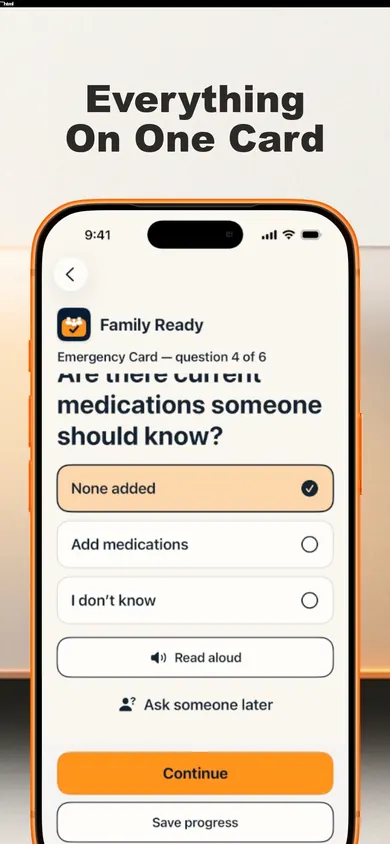
Night 4 is the one we built an app for. Family Ready asks six questions per person and saves an Emergency Card on your iPhone that opens without internet in a large-text Emergency Mode. You can make one for yourself, each child and a partner, and print a free, dated Emergency Snapshot PDF for the fridge.
The rest of the challenge needs no app at all, and we’d rather you did it on paper than not at all.
Honest limitsWhat seven nights won’t cover
- Your local hazards. Hurricanes, wildfires, earthquakes and floods each need their own steps. Check your city or county emergency management site.
- Everything a “several days” kit implies. It’s a start, and it needs updating as kids grow and medicines change.
- Family Ready doesn’t call or text anyone for you, and Emergency Mode opens after your passcode. In an emergency, call your local emergency number.
- Family Ready is free for the card, the plan, the kit checklist and the Snapshot PDF. Invitations, household sync and reminders are in the paid Plus subscription.
Not for everyoneSkip the challenge if…
- You already have a written plan. Just do night 7, the drill, and put a review date on the plan.
- A child has complex medical needs. Build the plan with their care team. Seven evenings is too thin for that.
- Your kids are toddlers. Do nights 1 to 6 as adults and keep the drill short and calm.